1. Why autumn is a pivotal season for your cellar
Autumn is not just the time for harvest and falling leaves; it is also the moment when your home and cellar regulation systems are put to the test. As outdoor temperatures drop sharply, the inside of your cellar experiences thermal variations that can hinder the wine's aging cycle.
Wine is a living substance, extremely sensitive to thermal consistency. A rapid fluctuation, even by a few degrees, can cause the liquid to expand and contract, thus altering the cork and promoting premature oxidation. In autumn, the transition from summer heat to damp coolness creates a thermal shock if your cellar is not perfectly insulated.
2. Understanding the impact of thermal variations on wine
Wine aging is a slow chemical reaction. For this evolution to be harmonious, the temperature must remain between 10°C and 14°C. If the temperature drops too low in autumn, the maturation process stops abruptly; while not dangerous in itself, the risk lies primarily in the instability.
Using an application like VinoCellar allows you to monitor temperature changes in real-time. Thanks to connected probes, you receive an alert as soon as the environment deviates from the safety zone, allowing you to take action before your most fragile vintages are impacted.

Humidity management as a complement
Temperature is closely linked to hygrometry. In autumn, outdoor air can become drier or, conversely, very humid depending on your region. An ideal rate should be between 60% and 75%. If the temperature drops, relative humidity can increase mechanically, promoting the appearance of mold on labels, which depreciates the aesthetic and market value of your bottles.
3. Step-by-step method to stabilize your cellar
To navigate the autumn season with peace of mind, here is the procedure to follow to ensure the longevity of your collection.
Step 1: Insulation audit Before the first frosts occur, check the seals on your cellar door. A poorly closing door is the primary cause of temperature variation. If you have an underground cellar, ensure that no heat source (boiler, piping) is in the immediate vicinity.
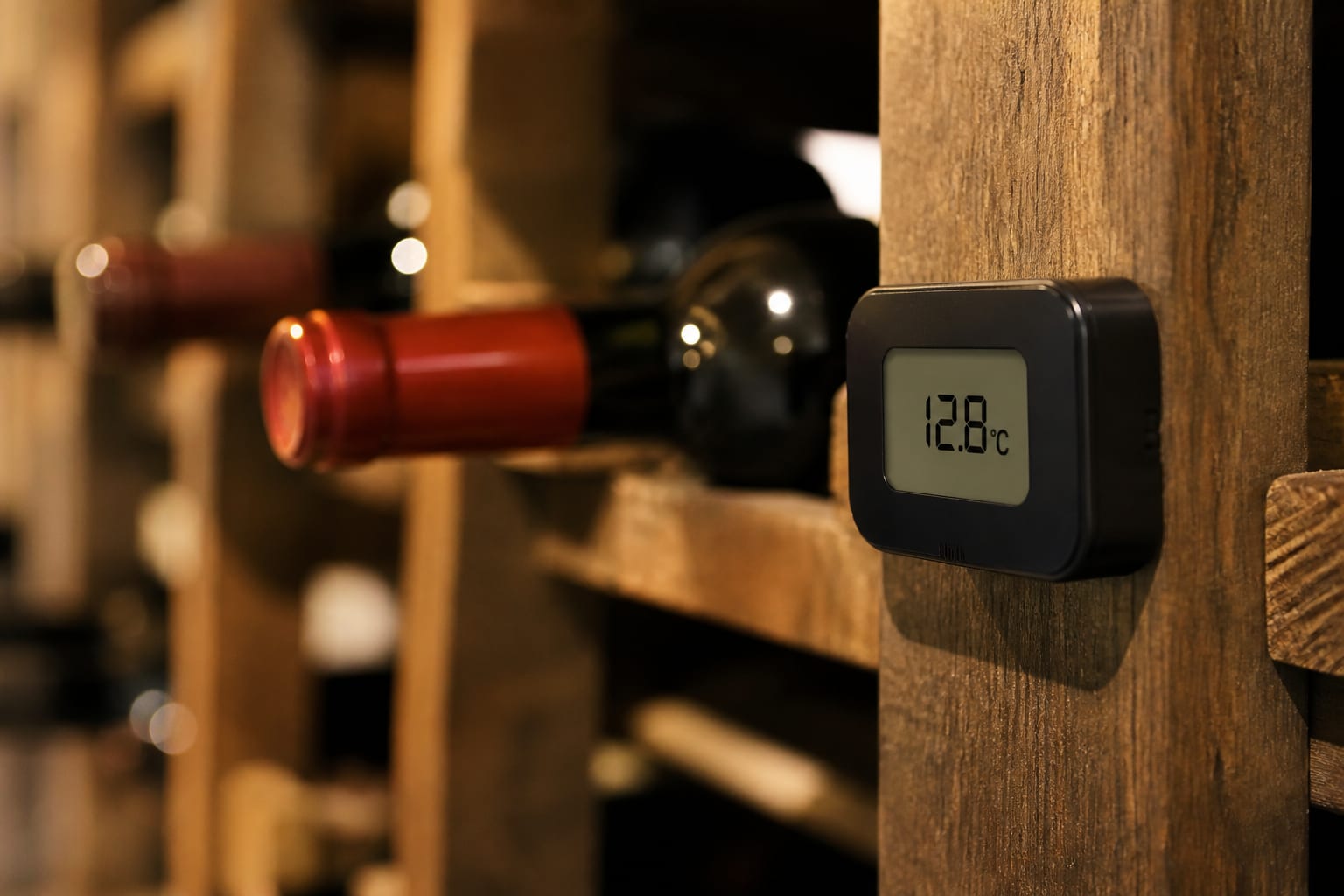
Step 2: Precise monitoring Do not rely on your cellar's built-in thermometer, which is often inaccurate. Install an independent sensor. With the VinoCellar application, you can centralize this data. If the temperature drops, you will be able to adjust the room's heating or review the thermostat of your electric cellar if it is equipped with one.

Settings
Optimize your parameters via the VinoCellar interface.
Vigilance
Monitor alerts on your smartphone daily.
4. Common mistakes to avoid
The first mistake is wanting to "help" the wine by changing parameters too abruptly. Wine hates brutality. If you notice a temperature drop of 2°C, do not increase the thermostat by 5°C all at once. Proceed in increments of 0.5°C.
The second mistake is storing non-wine items in the cellar during autumn. Volume variations in the room change the thermal inertia. A well-stocked cellar is more stable than a half-empty one, as the liquid mass itself acts as a thermal buffer.
5. Anticipate to enjoy better
By stabilizing your cellar this autumn, you are also preparing your wines for winter tastings. A wine that has spent a calm autumn will be more ready to reveal its complex aromas during your end-of-year meals. Using VinoCellar is not just a matter of technique; it is a guarantee of serenity for every enthusiast concerned about their cellar.



Comments (0)